
Theleme Partners: Patrick Degorce’s Silent Compounder
From TCI co-founder to Mayfair recluse, Degorce has built a concentrated book spanning Moderna, TransUnion, Equifax, Uber, Meta, Amazon, Robinhood, Flutter, and Sify.
See every manager’s holdings at www.alpha-file.com
I started this series with 1. TCI — Chris Hohn’s monopolies-and-toll-roads machine, coming off the largest single-year profit in hedge fund history. The second was 2. Windacre Partnership — Snehal Amin, who learned the trade as a founding partner at TCI before going out on his own. Which brings us to the third name. While Snehal Amin was a partner at TCI. Patrick Degorce co-founded it.
In 2003, Degorce — a French former navy officer who’d spent seven years running European equities at Merrill Lynch Investment Management — helped found and build The Children’s Investment Fund. He was there for the ABN AMRO break-up, the campaign that ended in the largest bank takeover in history. He was there for the whole activist crusade that made TCI’s name. And then, in January 2009, he left to set up Theleme Partners and quietly threw away the one thing TCI was most famous for. No activism. No public letters. No proxy fights. Just a ferociously concentrated book of businesses he thinks are worth far more than the market says, held for the long term and mostly in silence.
There’s one more name worth flagging before we start, because it’s the reason you may already have heard of Theleme without knowing it. A young analyst followed Degorce out of TCI and became a partner at Theleme around its 2010 launch. His name was Rishi Sunak. Yes — the future Prime Minister of the United Kingdom cut his buy-side teeth at the fund in this profile, sitting a few desks from Snehal Amin. The whole TCI diaspora runs through this one small office in Mayfair.
Philosophy & Process
The firm is named after the Abbey of Thélème, the fictional utopia in Rabelais whose single rule was “Fay ce que vouldras” — do what thou wilt. It’s a fitting name for a fund that answers to no benchmark and no house style but its own. Three things make Theleme worth watching.
1. The concentration makes even WindAcre look timid. If WindAcre taking a single stock to 48% of the fund stopped you cold in the last piece, look at what Theleme does every single quarter. Across thirteen years of filings, Theleme’s largest position has been north of 25% of the entire book in almost every quarter, and it has repeatedly run past 40%. Schwab hit 37% of the fund in 2017. Wells Fargo, 35%. Bank of America, 30%. And Moderna, as we’ll see, touched 43.5%. The whole portfolio is usually six to twelve names. Where TCI diversifies across 10–15 monopolies and even WindAcre holds ten, Theleme routinely bets a third-to-a-half of everything on its single best idea, and has done so for over a decade. This is the punch card sharpened to a needle.
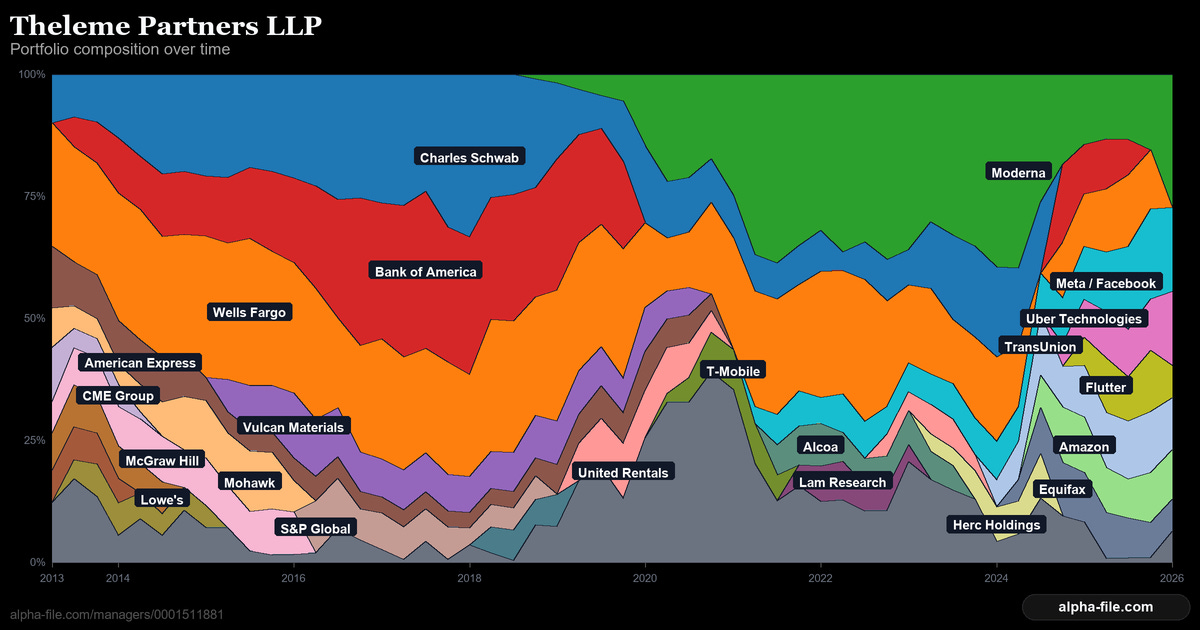
2. It’s the TCI quality instinct, minus the activism, plus a taste for the misunderstood. Look at the first decade of the book and it’s a wall of financials: Wells Fargo, Bank of America, Charles Schwab, American Express — held in enormous size, straight through the long grind of the post-crisis bank recovery. Sprinkled around them were quality compounders that would make Hohn nod: S&P Global (a toll on debt, 2016–2018), Vulcan Materials (aggregates), United Rentals. The names change but the instinct doesn’t: find a high-quality business the market has misjudged, understand it better than anyone, and then — this is the un-TCI part — don’t wage war on management. Just buy an enormous slug of it and wait. Degorce took the analytical engine he built with Hohn and pointed it at conviction rather than confrontation.
3. When Degorce believes something, he is willing to look completely, career-riskingly wrong for years. TCI’s tell is that it sells the moment a thesis cracks. WindAcre’s is that it refuses to sell at gunpoint. Theleme’s is stranger and harder: it will hold a position through a 90% drawdown without flinching, because the conviction was never about the price. There is no better example in all of finance than the one that made Degorce his fortune — and it’s the opposite of a boring monopoly.
Moderna — the conviction bet that broke every rule
Everything about Moderna is wrong for a value investor. It’s a biotech. When Degorce first backed it, it had no product, no revenue, roughly ten employees, and a valuation around $125 million. This is not a toll road. This is a science experiment.
But the story of why he owned it is the key to the whole firm. According to the Wall Street Journal‘s 2020 profile — headlined, memorably, “The Millionaire Who Gave Moderna a Shot” — Degorce first invested privately around 2011, not as a portfolio decision but as a personal one: his wife had been diagnosed with stage 4 cancer, he went looking for the science that might save her, and he found a tiny Cambridge, Massachusetts company betting that messenger RNA could turn the human body into its own drug factory. He funded a grant reported at $500,000 to pay for its first two oncology scientists. He believed in the platform, in the most literal way a person can, years before the world had heard of it.
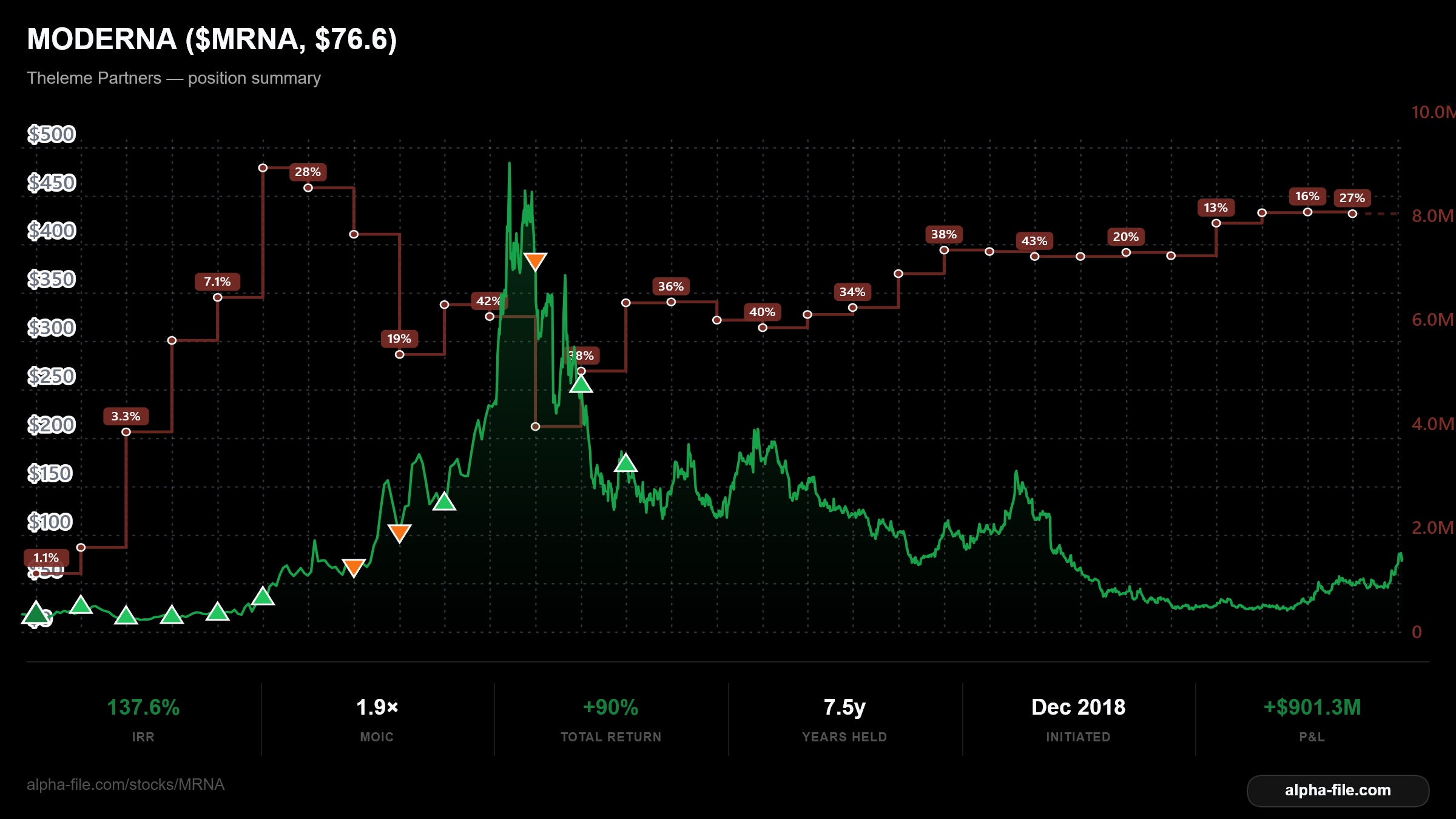
Then the position shows up in the filings, and you can watch the conviction compound in real time. Moderna first appears in Theleme’s 13F in the fourth quarter of 2018 — the very quarter it IPO’d — at 1.1 million shares, about 1% of the fund. A starter. By the end of 2019 it was 6.4 million shares and 7%. Then COVID-19 arrived, the platform Degorce had believed in for a decade became the most important company on earth overnight, and the position went vertical: 21.8% of the fund in Q1 2020, 27.8% by that summer.
Here’s the part most people miss, and it’s the part that makes it great investing rather than dumb luck. Degorce sold into the euphoria. As Moderna went from $20 to over $450, Theleme cut the share count from 8.5 million in mid-2020 to under 4 million by late 2021 — and yet the position still ballooned to 43.5% of the fund, because the price was rising faster than he could trim. He was taking chips off a table that kept getting bigger.
And then the truly hard part. Moderna peaked and collapsed — from over $450 to under $30 — one of the great round-trips of the era. A lot of investors rode it up and rode it all the way back down, or bailed at the bottom in disgust. Theleme did neither. As the stock fell, Degorce bought it back, rebuilding the share count from ~4 million to over 7 million through 2022–2024, holding a 40%+ position through the whole descent. As recently as Q1 2025 it was still 16% of the fund with the stock in the low $20s.
Look at where it sits today. In the most recent filing, Moderna is 8.0 million shares, roughly $410 million, and back to 27.2% of the fund — the weight nearly doubling in a single quarter as the stock finally re-rated off the bottom. Eight years, a 20-bagger, a near-total round-trip, and a partial recovery — and Degorce has held it, in size, the entire way. The single most important number in this portfolio isn’t the current price. It’s the fact that he never blinked.
What Does Theleme Own Today?
Below is the entire book — nine names, about $1.5 billion of disclosed US equity, as of the last 13F. As always, this is the US-listed long book only; Theleme’s true fund is smaller than it once was (it managed north of $3 billion at the 2020 peak) and holds things a 13F never shows. You can pull this same view for Theleme, or any manager, on Alpha-File.com, click through each holding for fundamentals, and export the lot for free.
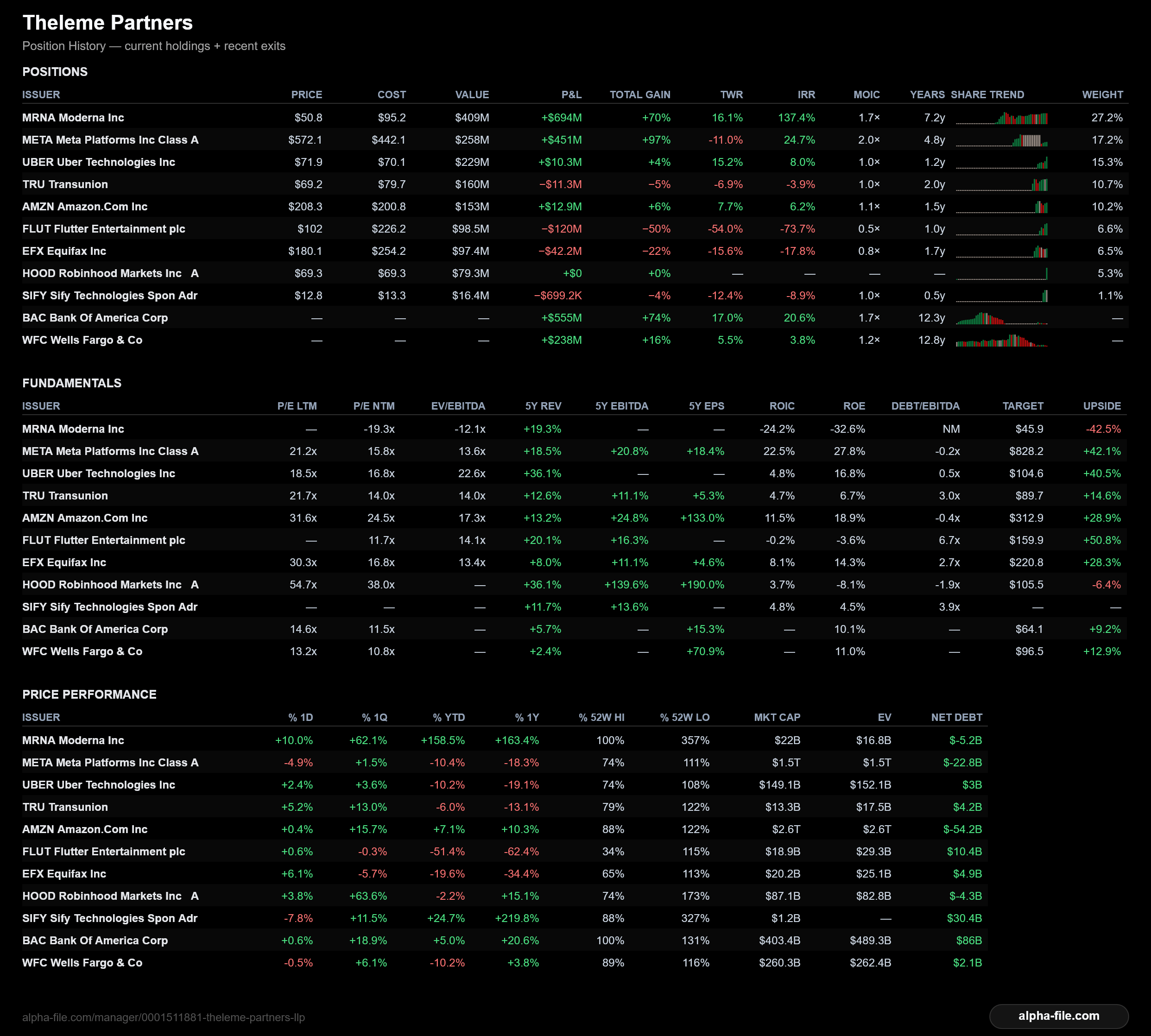
If I had to describe the book in one line, it’s misunderstood quality, bet enormous — with Moderna the moonshot at its heart and, around it, a cluster of exactly the kind of network-and-data monopolies the whole TCI family loves. The single loudest signal in the latest filing, beyond Moderna’s re-rating, is a farewell: Theleme just sold Wells Fargo entirely — the last of the great bank bets, held since the first filing in 2013. An era ended this quarter.
TransUnion & Equifax
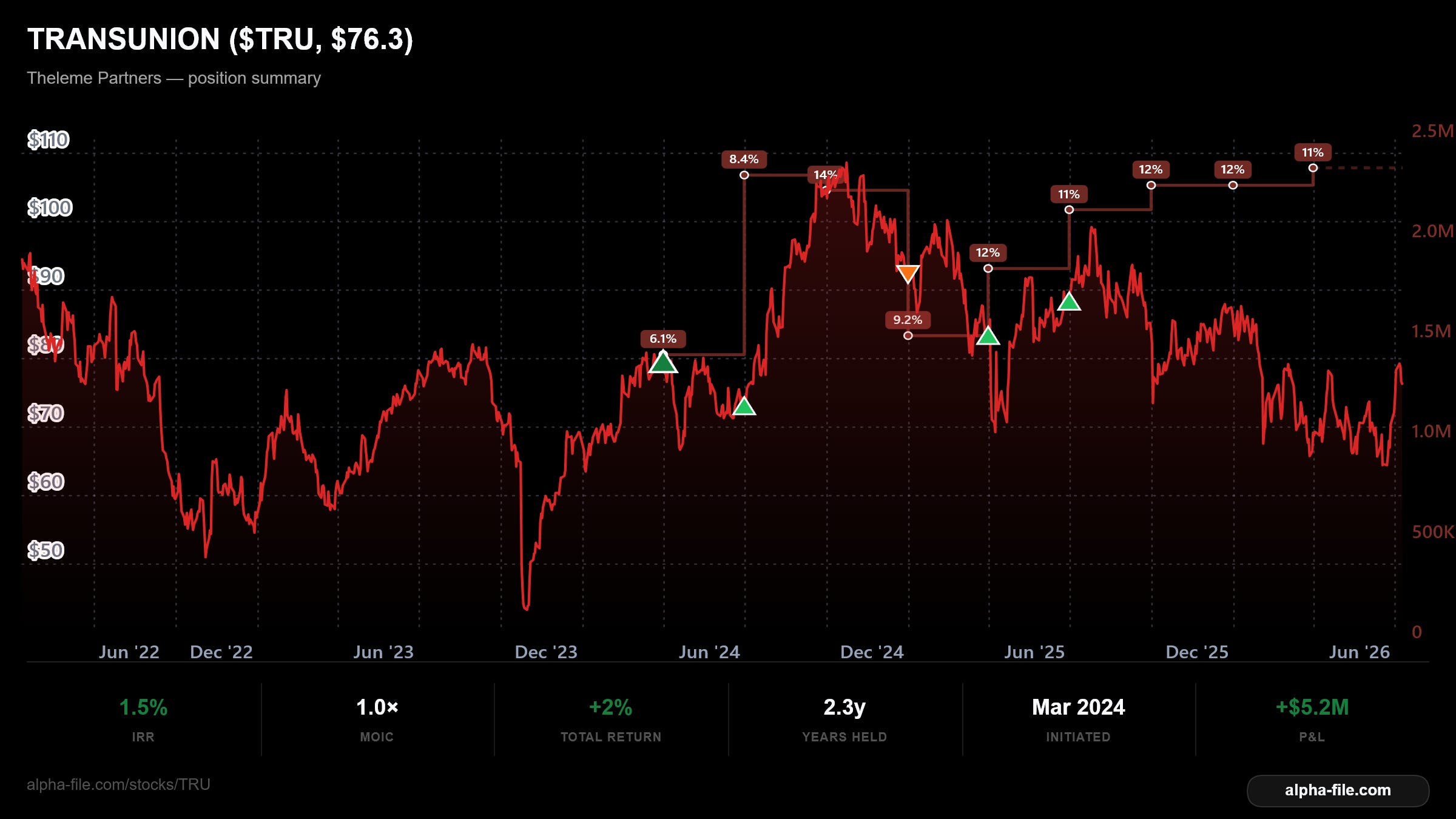
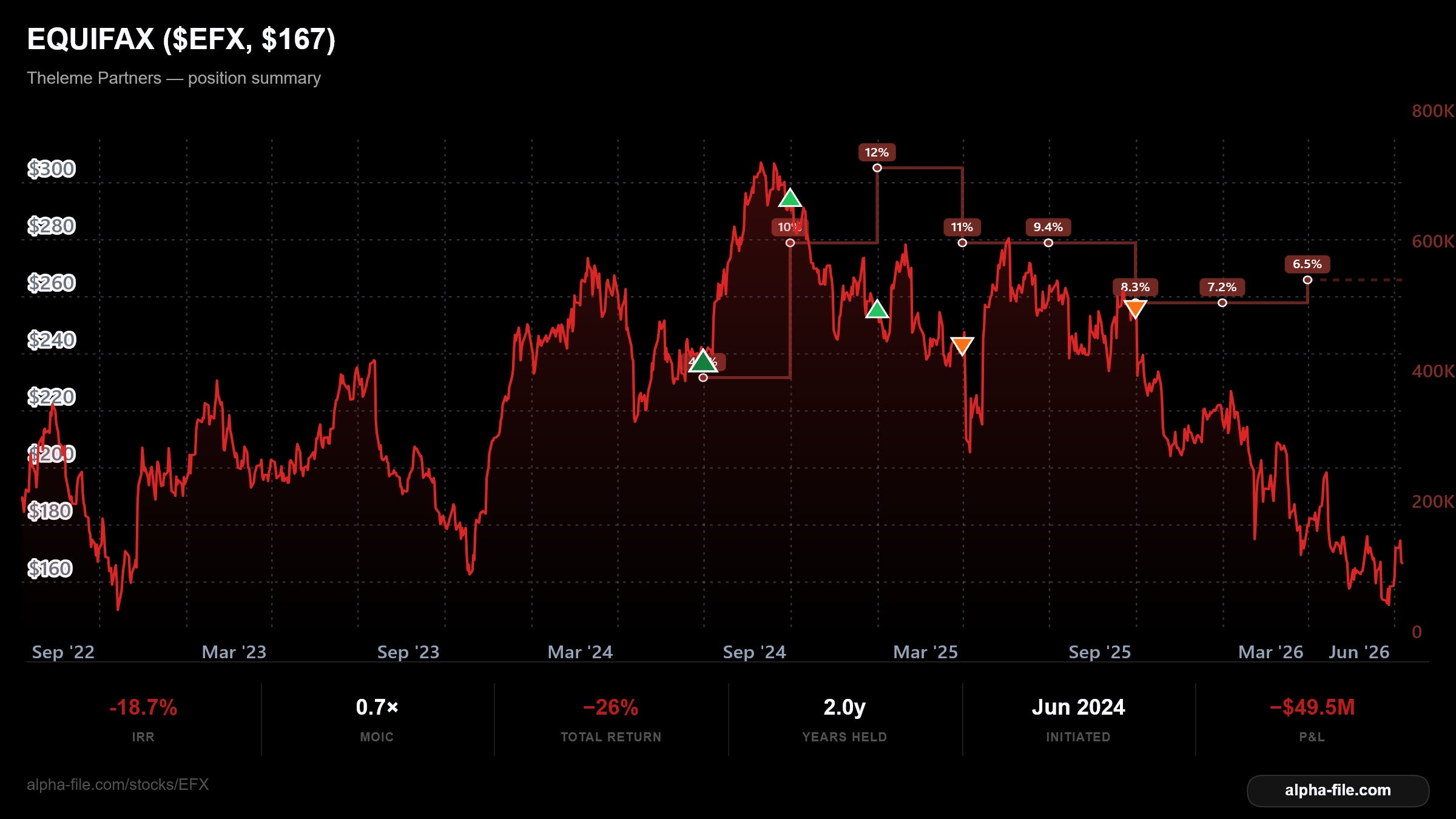
Here’s where the TCI songbook rings loudest. Theleme owns TransUnion (10.7%) and Equifax (6.5%) - together about 17% of the fund, a deliberate double-bet on the US credit-bureau oligopoly. But the bet is more specific than “credit reports are toll roads.” It is a bet on the plumbing of consumer credit at a moment when that plumbing looks optically ugly: mortgage volumes have been crushed by 6-7% rates, FICO pricing has made the whole ecosystem look noisy, and investors are arguing about VantageScore, tri-merge, and whether the bureaus lose economics. Underneath the noise, the basic business is still gorgeous. Lenders, insurers, landlords, telecoms and fintechs contribute data because they need the network, then pay to consume it when they underwrite, price, verify, market or fight fraud. AI does not recreate that from the open web. If anything, it makes fresh, permissioned, regulated data more valuable.
The split between the two names matters. Equifax is the more mortgage-levered and payroll-data-heavy of the pair. Its crown jewel is Workforce Solutions / The Work Number, a payroll and employment-verification database with records on roughly 138 million US individuals, used early in lender and background-check waterfalls because the hit rate is highest. If rates fall, Equifax gets the mortgage rebound twice: more credit pulls and more income-verification checks. TransUnion is the cleaner “bureau becomes identity platform” story. Its OneTru platform is meant to pull credit, identity, device, phone, marketing and fraud data onto one AI-enabled cloud stack, so the same consumer graph can underwrite a loan, target an offer and stop a scam. The bear case is real - mortgage still needs rates to cooperate, Work Number pricing is attracting competitors, and TRU has to prove the non-credit products keep compounding - but the thesis is much better than a sleepy bureau multiple. These are scarce, regulated identity graphs sitting inside more and more automated decision workflows.
Meta, Uber & Amazon
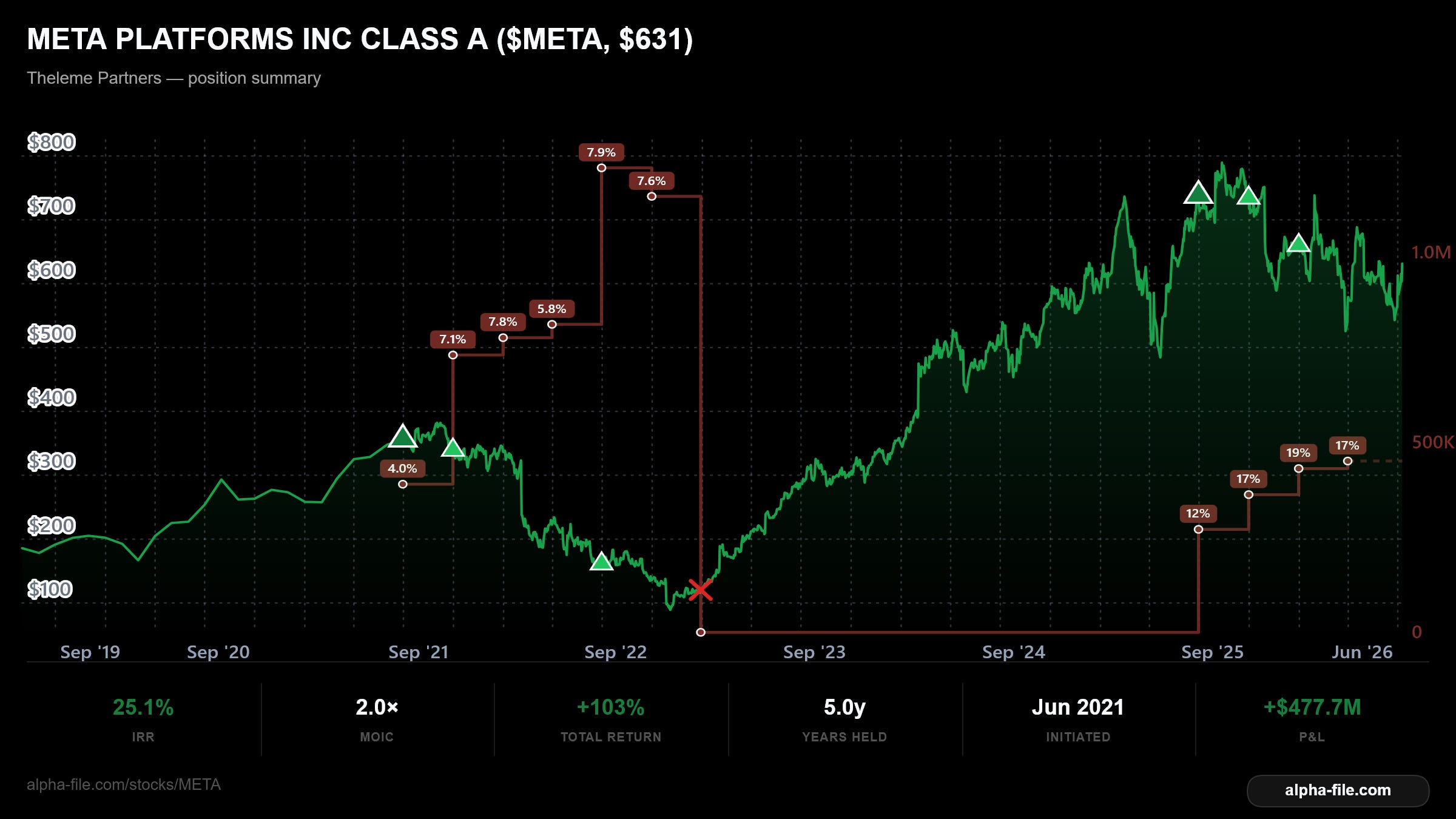
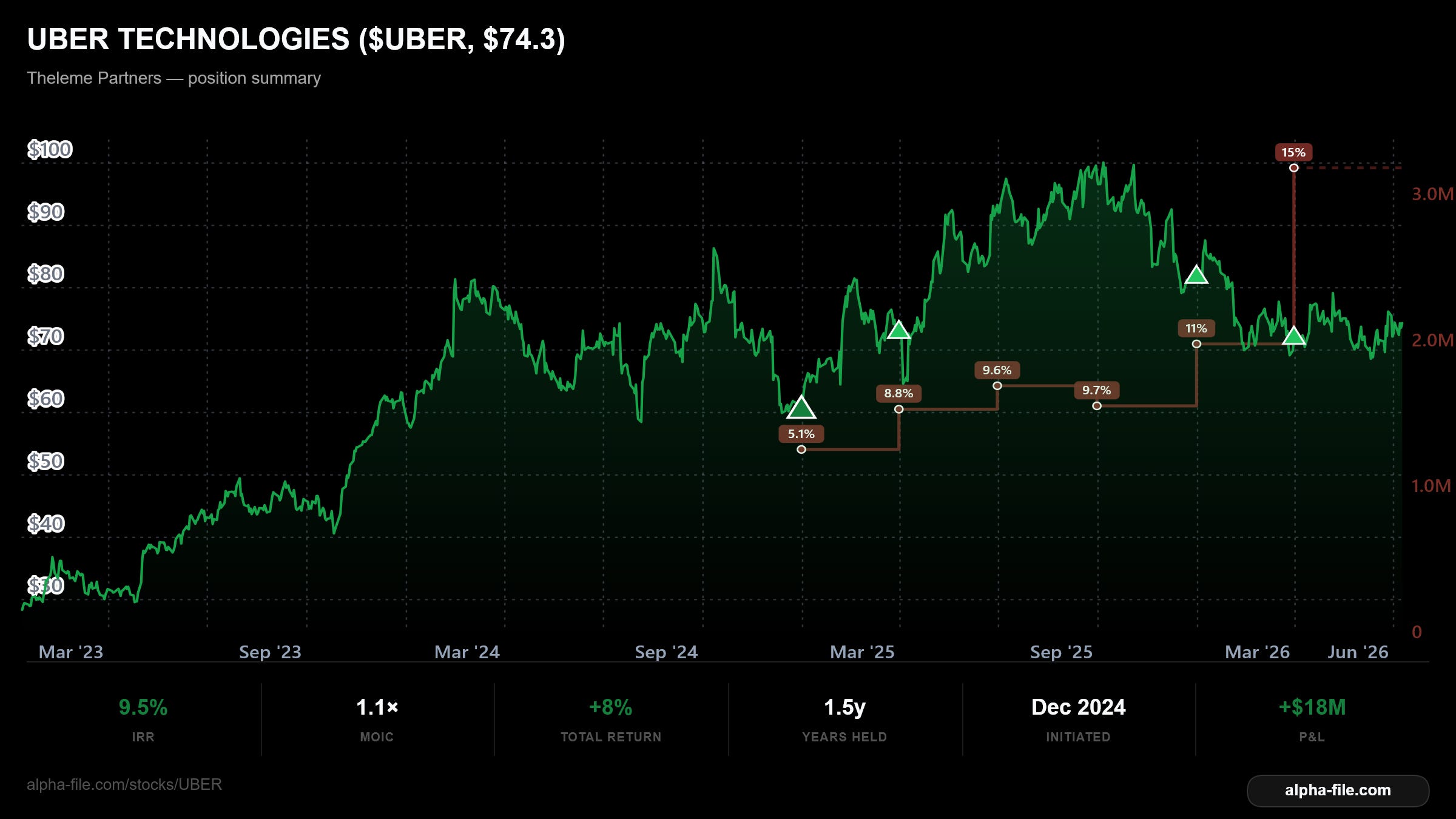
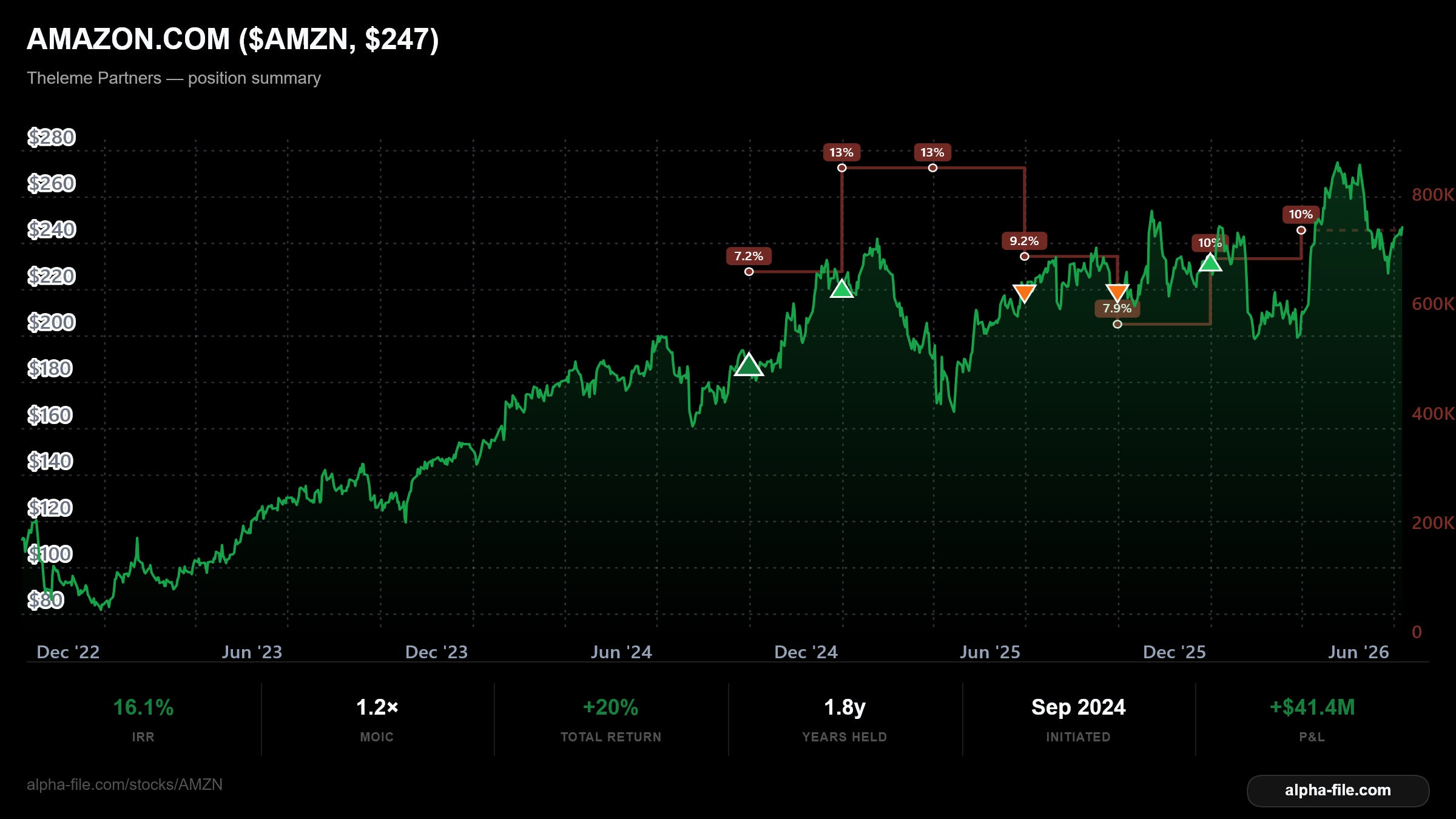
The rest of the concentrated core is a trio of the best consumer platforms on earth, each bought as a misunderstood compounder. Meta (17.2%, the #2 position) has been in the book since late 2021 — held through the 2022 “is-the-metaverse-a-black-hole” panic that took the stock to $88, and vindicated since. Uber (15.3%) was more than doubled this quarter, from 2.0 to 3.2 million shares — Theleme’s biggest active add — a bet on the ride-hail-and-delivery duopoly now that it finally gushes cash. And Amazon (10.2%), added through 2024–25, needs no introduction: retail flywheel plus the highest-margin toll booth in technology, AWS. Three two-sided networks, each with a moat you cannot buy your way into, each sized like a normal fund’s entire top-three.
Robinhood & Flutter — the newer bets
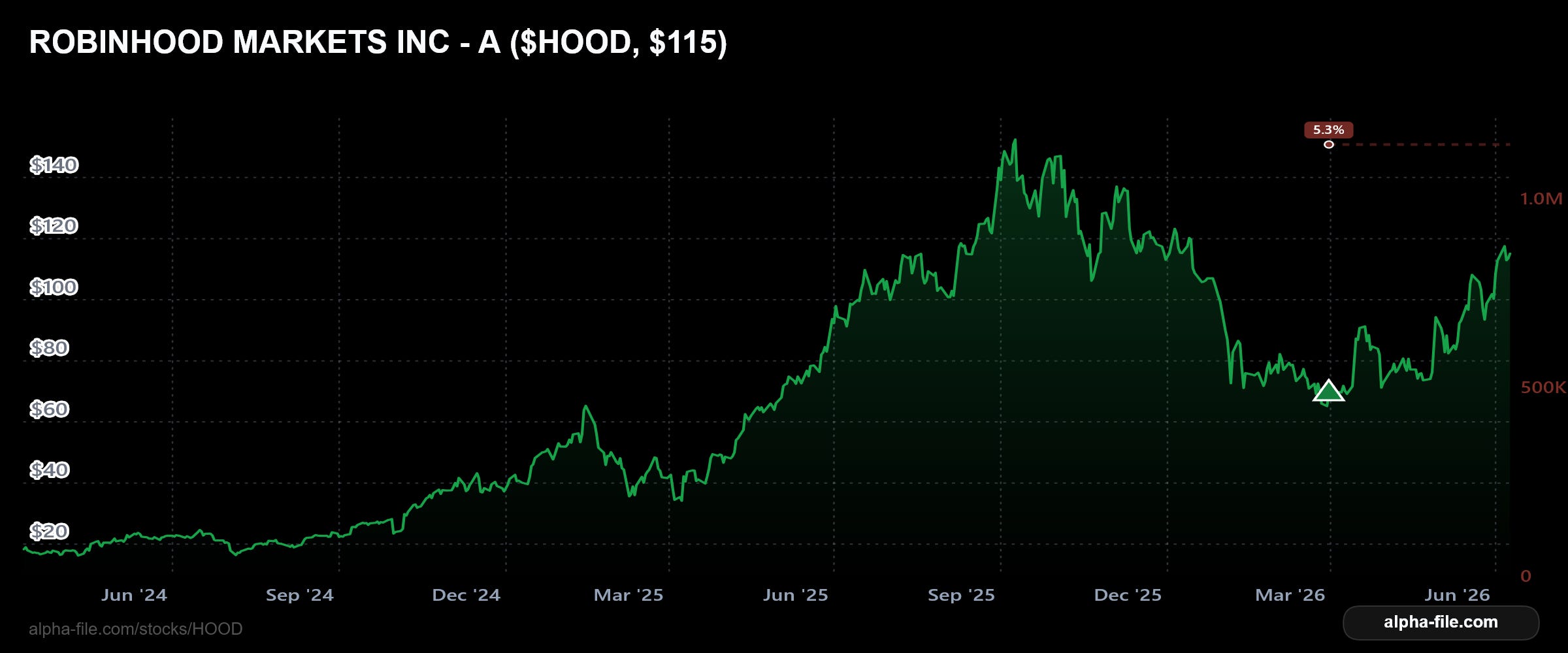
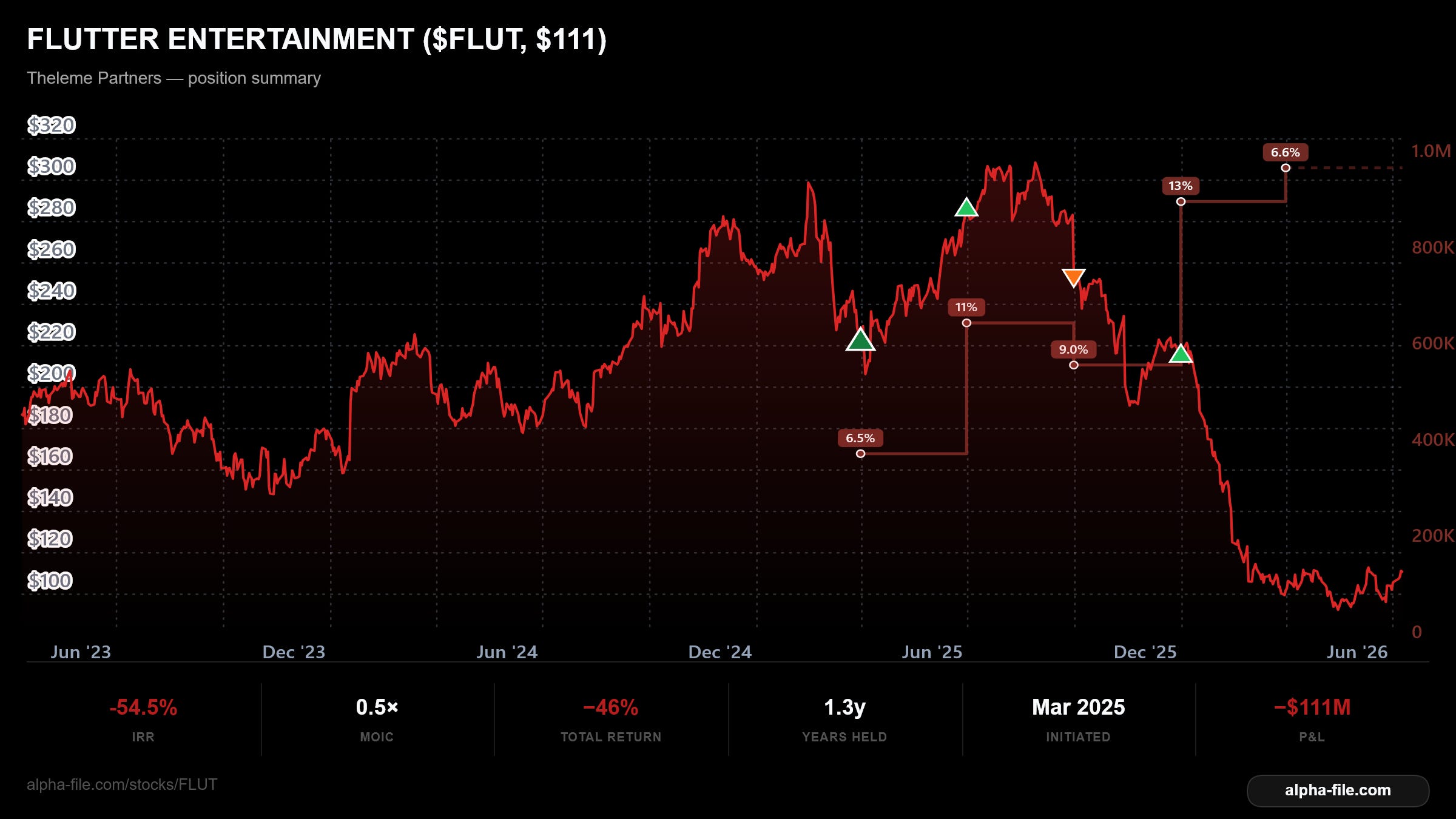
Two smaller, more opportunistic positions round it out. Robinhood (5.3%) is brand-new this quarter - a levered play on retail trading, crypto and the millennial brokerage account, from a firm that has always loved a financial-platform story (recall the Schwab history). Flutter (6.6%), owner of FanDuel, is the dominant player in US online sports betting - another two-sided network in a market that’s still barely a decade old.
Sify - the tiny data-center option
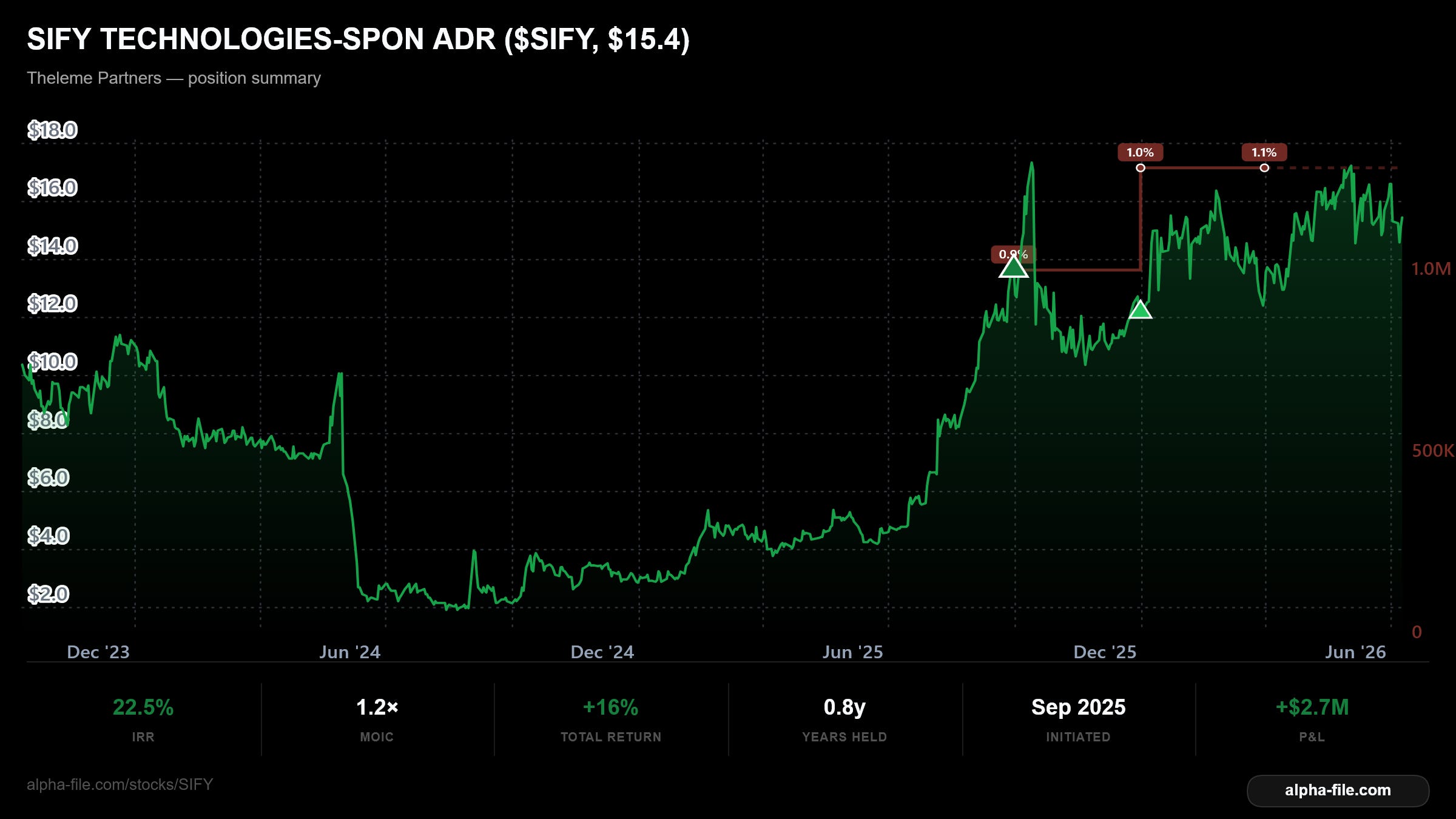
And then there is Sify (1.1%), which looks, at first glance, like a throwaway Indian IT-services ADR. It is not that neat. Sify is one of India’s old internet-infrastructure names, but the interesting asset today is physical: 14 data centers, 227+ MW of IT power, expansion toward 407+ MW, and campuses the company says can scale close to a gigawatt. In FY2026, data centers were roughly 39% of revenue but the majority of segment operating income, with most of the assets and capex sitting there. The data-center subsidiary has even filed draft IPO papers in India, which tells you where the market is trying to put the value.
So the play is not “small Indian IT services.” It is a tiny, levered call option on Indian digital infrastructure: data localization, cloud migration, hyperscaler demand, AI inference at the edge, and the need for carrier-neutral capacity in a market whose data usage still dwarfs its domestic data-center footprint. The caveat is that this is not a clean US-style data-center REIT; it is an asset-heavy telecom/cloud hybrid with real depreciation, interest expense and financing needs. But as a 1% tail position, it reads much more like an option on Indian data-center scarcity than a sleepy services company.
The Ghosts — Theleme’s Bank Decade
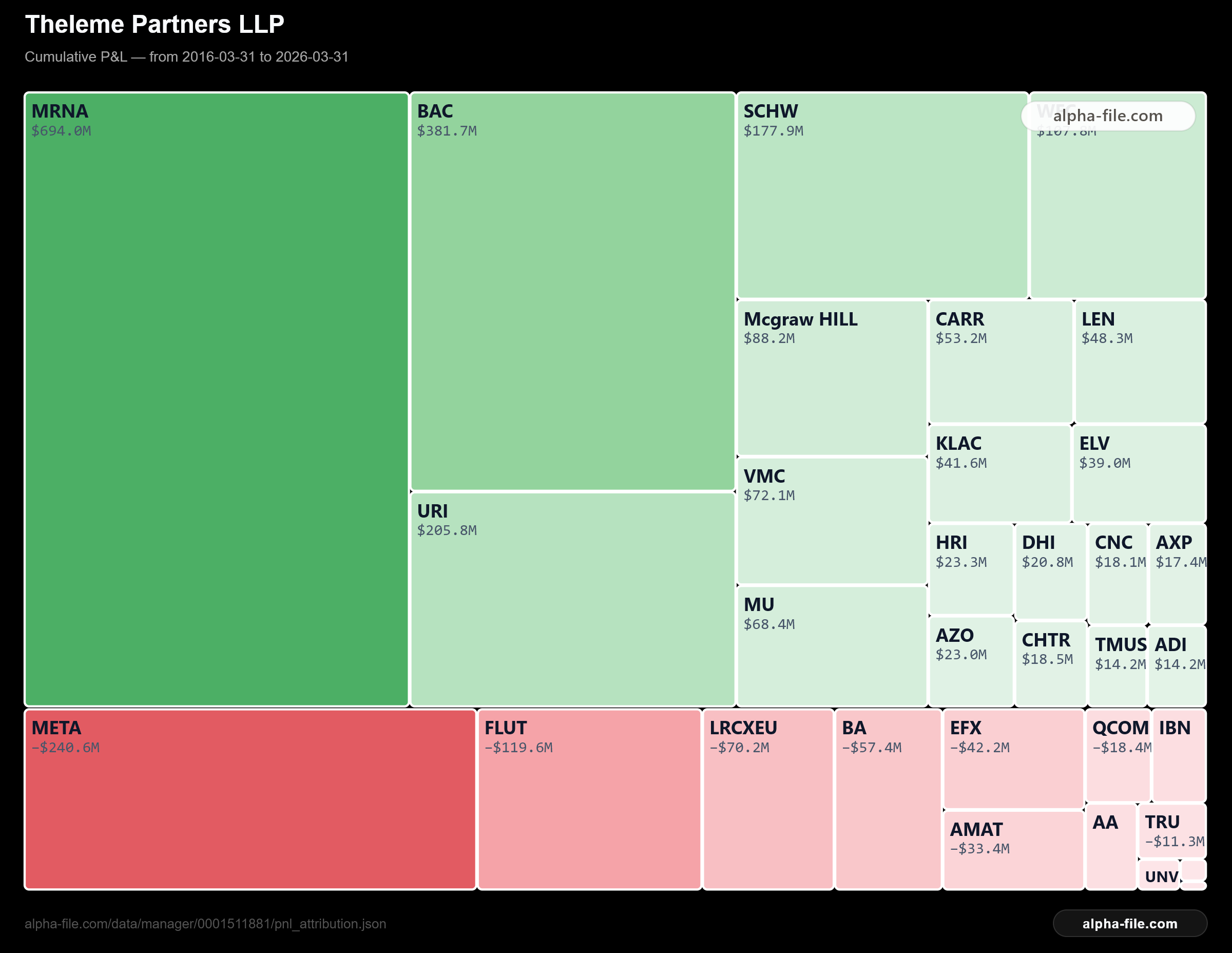
Part of the fun of a book this small is that the whole history fits on one page, and Theleme’s history is really two chapters: the financials decade, and the quality-tech pivot. Alpha-File.com keeps every filing. A few ghosts worth knowing:
Wells Fargo (2013–2026) — the spine of the fund for twelve years, up to 35% of the book, and only just sold. If Moderna was the head, WFC was the backbone.
Charles Schwab (2013–2018, then 2022–2024) — twice a monster, peaking near 37% the first time. Degorce clearly rates the brokerage model; Robinhood looks like the third act.
Bank of America (2013–2019) — a ~30% position at its height, ridden through the post-crisis recovery.
American Express (2013–2020) and S&P Global (2016–2018) — the toll-on-spending and toll-on-debt names, both sized around 12%.
United Rentals (2019–2023) and Vulcan Materials (2015–2020) — the industrial-cyclical bets, each a mid-teens position, straight out of the same playbook that has WindAcre in Roper and TransDigm.
What Happens Next
Theleme just told you what it thinks, in the only language it speaks. It buried the last bank, doubled Uber, opened Robinhood — and let Moderna swell back to more than a quarter of the fund as the market finally came back around to the bet Degorce placed fourteen years ago, for the most human reason imaginable.
Watch the next filing. Does Moderna keep climbing back toward its old 40% perch, or does Degorce trim into strength again the way he did in 2021? Does the credit-bureau double-bet grow into the new anchor? Does anything get taken over — or does the fund, quietly shrinking, simply keep doing what it has always done: own a handful of misunderstood things, in enormous size, and say nothing? Theleme moves in near-total silence. The portfolio is the only interview you’ll get.
I’ll be tracking every filing on Alpha-File.com, where you can pull this same view — position history, initiations and exits, fundamentals, concentration and cumulative P&L — for Theleme or any manager, free. If you enjoyed this, subscribe: the next profile in the series is already in the works, and it’s a change of pace — the London giant that does the exact opposite of everything you just read.
Nothing here is investment advice. All position data comes from SEC 13F filings as aggregated on Alpha-File.com; biographical and deal details are drawn from public reporting (The Wall Street Journal, Institutional Investor, City AM, Companies House, the Good Law Project and mainstream UK press) and reflect the best available sources as of July 2026. The Moderna/Sunak passage describes allegations that have never been proven and notes the relevant denials; it is included as public-record context, not as a claim of wrongdoing by any person.